Interconnection Application Review

Interconnection Application Review

Duration

May 2025 – Now

Company

X, the moonshot factory (formerly Google X)

Role

Sole UX designer (research, UX, UI, prototyping)

Some details in these case studies have been simplified due to confidentiality — feel free to reach out for a more in-depth walkthrough or the full portfolio deck.

‍

Problem

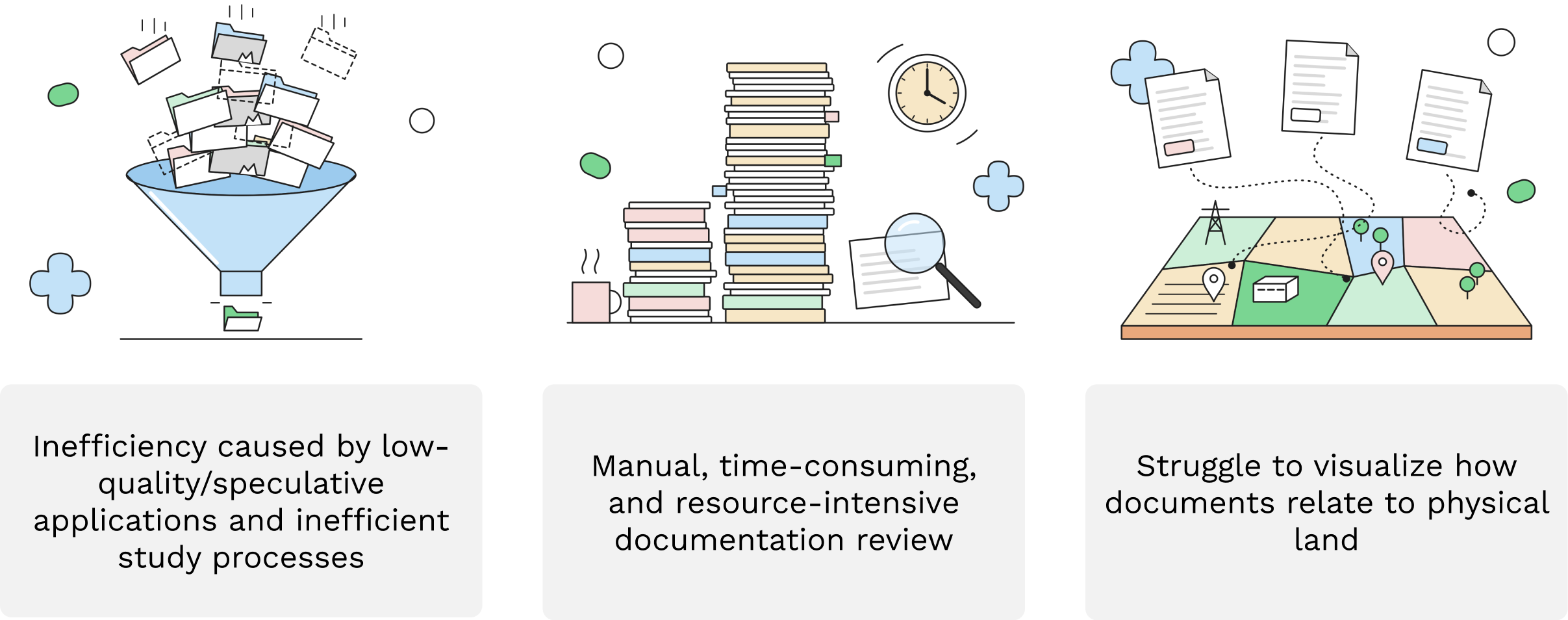
Before a power plant can connect to the grid, planners review a stack of documents behind each interconnection application, then work out how a site’s approved acreage maps to the physical land. It was slow, manual, and hard to scale as the number of applications grew. I designed HyperQ, an AI-powered tool that organizes those documents, flags compliance, and lets planners verify every finding against the source.

‍

‍

‍

‍

‍

Solution

What I did

Made the status readable at a glance. I redesigned how compliance is scored and visualized: a swimlane view where each facility type shows what was submitted against what is required, replacing dense number tables.

‍

Designed for progressive disclosure. Planners move from “is it ready?” to “where does it fail?” to “why?” to “which file?” to “show me the source”, one layer at a time, so they only see as much detail as they need.

‍

Built trust into the interface. Every AI finding links back to the exact passage in the original document. AI suggests, the planner decides, with clear marks for AI-generated content and room to verify or correct it.

‍

Used user evidence to shape scope. Engineering first preferred document-level summaries because they were simpler. I prototyped agreement-level grouping, which matched how planners think, tested it with users, and it ranked as a top priority. That brought engineering on board and we shipped it.

‍

‍

Impact

Review time cut by 20x+ (from ~6 hours per application to a ~6 minute runtime plus ~18 minutes of review)
‍
99% of applications processed in under an hour
‍
811 applications processed in the first cycle, representing 220 GW, more than PJM’s entire existing grid

‍

‍

‍

Takeaways

Trust is a design problem, not a model problem. Speed only mattered once planners believed the result. Showing the system’s reasoning, instead of hiding it, is what turned a fast tool into one people actually used.

‍

Influence is a core skill. A good design doesn’t sell itself. Aligning engineering took a quick prototype and real user feedback, not just a strong visual. Influencing without formal authority mattered as much as the design itself.

‍

Prototype with real data, earlier. Real model output reads very differently from placeholder content, so format and length matter. Starting with real data would have sharpened my designs sooner.
‍

Other PROJECT